Calling All Celebrities

Let there be no doubt that Irving Wallace was a first-class self-promoter! Today, I came across a box entitled, “THE MAN: Unsigned carbons of celebrity mailing,” which contains copies of hundreds of letters that Wallace sent to noteworthy individuals along with advance copies of his new novel, The Man, in 1964. Wallace’s recipients were a varied bunch of political, literary, and artistic heavyweights, from Harry Truman and Lyndon Johnson to Jean-Paul Sartre, Martin Luther King, Jr. to comedian Jack Paar of The Tonight Show. Wallace even wrote to an aging Pablo Picasso in Cannes, declaring himself “an admirer” of the legendary painter’s work and insisting that Picasso need not reply to his letter. (Picasso was surely relieved).

Here’s the letter in full:
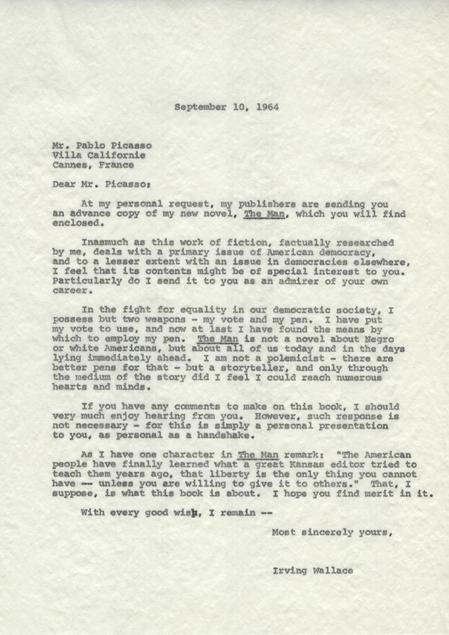
Image (12).jpg

This box of letters underscores Wallace’s fearlessness–some would even say brazenness–in selling his work. As somebody who dedicated himself to a writing career at a young age, Wallace never hesitated to sing his own praises or expound on the importance of his work to any journalist who might listen; these activities were integral to his professional success and economic well-being. By 1964, following the huge success of The Chapman Report, Wallace appears to have decided that an ambitious writer needed an aggressive media strategy, and that an aggressive media strategy could only benefit from outreach to prominent cultural figures in the U.S. and Europe. (It’s also fair to say that Wallace was becoming impressed with his growing celebrity). Whether any of these individuals returned Wallace’s letter is another question, and one which I’ll be eager to find out.
Visiting the White House

In September 1963, Irving Wallace visited the White House to conduct research for his novel The Man. He was shown around the grounds and offices by Pierre Salinger, JFK’s press secretary. Wallace’s notes from the trip make for fascinating reading. I’m particularly struck by the fact that the White House was not known as intimately by the public then as it is today. Whereas a contemporary researcher can access almost unlimited images, videos, and writings which promise to take us “inside” this most famous of American domestic spaces, Wallace appears to have been relatively ignorant about the building’s inner life prior to his visit.

A case in point: Wallace refers to what we now know simply as the Oval Office–familiar from endless presidential speeches and Saturday Night Live sketches–as “the President’s Office or Corner Office,” further noting that “the President’s room is round or almost round.” Albeit a small detail, this point underscores how our idea of the presidency is subject to the ebb and flow of potent symbols, images, and public memories. In our media-saturated conception of the presidency (which arguably began with JFK and the access his administration granted to photographers and writers), the inside of the White House has achieved a level of mass familiarity and symbolic currency that it did not have, say, in the 1860s.

Here’s one more nugget from Wallace’s White House notes, which I think is worth quoting in full. Enjoy!

I studied the President’s desk carefully…The President has a tall backed executive chair, swivel, black. A green matted writing board at right elbow. To his left on desk he has a green phone with 18 punch keys, then another phone tying him into the Signal board, a single phoned [sic], then to his right a black phone like any phone which Salinger called “the hot phone.” Wouldn’t tell me where it went to, except admitted domestic and said, “Oh, for your book say it ties straight into the Pentagon.”

The Many Sides of Irving Wallace

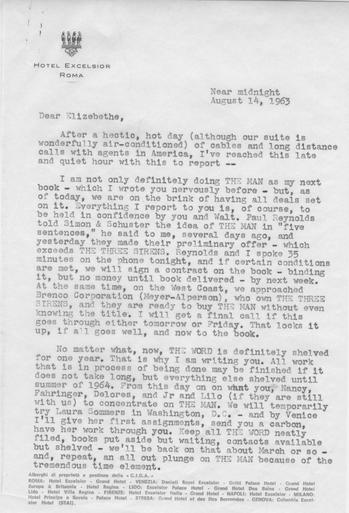
While traveling in Rome in August 1963, Irving Wallace sent word to his research assistant in California that he had received the green light for The Man, a speculative novel about the rise of America’s first black president. The letter, written in a midnight burst of energy and excitement, provides fascinating insight into the multiple sides of Irving Wallace’s nature.

There is, of course, Irving Wallace the writer; he calls The Man “the most important thing I’ve ever attempted” to write. Irving Wallace the researcher and delegator is present here, too, as evidenced by the thorough directives Wallace lays out for his research assistant. One particularly urgent task was to clarify the line of presidential succession in the event of assassination. Wallace tells his researcher to “locate at UCLA, Pomona, USC, [or] U of C some very very smart political science or Washington expert, a graduate or instructor, who would be willing to answer questions for payment” about succession procedures. “I don’t understand it all,” Wallace lamented. “This is important and not too soon to get to work finding someone” who could provide expertise. Wallace’s preoccupation with presidential succession seems eerily timed; John F. Kennedy was assassinated a mere two months after this letter.

Last but not least, the letter gives a clear picture of Irving Wallace the businessman and publicist. Wallace wanted to write and publish The Man in time for the 1964 election, which, he was sure, would boost his sales. “Now my situation is this,” he explained. “To beat anyone else with a parallel idea AND to come out before the 1964 Presidential election.” Wallace saw The Man as a “big deal,” and he wanted to be sure that nobody else beat him to the punch. As far as we know, nobody else did. The Man spent 38 weeks on the New York Times bestseller list for 1964.

The Man

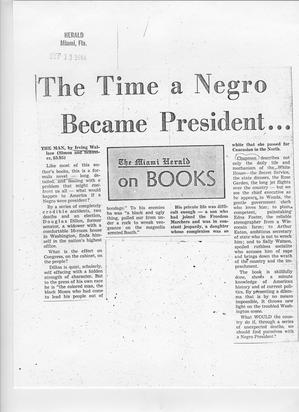
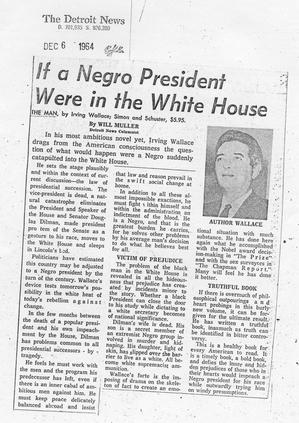
Just in time for election season, I’ve begun processing materials related to Irving Wallace’s book The Man (1964), which tells the story of America’s first African American president. Wallace’s protagonist, Douglass Dilman, ascends to the Presidency by accident, as a result of the deaths of the President, Vice President, and Speaker of the House (he is next in the line of succession). Dilman’s presidency is besieged by white supremacists, black political activists, and an attempted assassination. With its controversial premise and page-turning plot,The Man was a major success for Wallace, spending some 40 weeks on the New York Times bestseller list.

As I take my preliminary pass through newspaper reviews of the book, it’s hard not to wince at some of the headlines (see below). To be sure, The Man was something of a cultural moment, and the book’s coverage by the mainstream press poses many questions for students of race and American politics in the Civil Rights era. How, we might ask, was Wallace’s book received by the mainstream press? Was the book’s premise seen as sensational or realistic? And what drove Wallace to write about the first black president?

Halloween Revelry

For this week’s blog, I wanted to take a break from my usual work and check in on the Claremont Colleges Digital Library. The CCDL provides access to a rich store of visual resources from across the Claremont Colleges community. I am particularly drawn to the site’s photographic collections of early Claremont, including the Boynton Collection of Early Claremont, the City of Claremont History Collection, and the Claremont Colleges Photo Archive. The images in these collections open a window into the people and landscapes of early Claremont as only photographs can. Trust me: you will get lost in these photographs! 

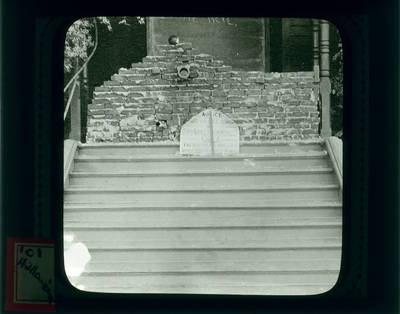
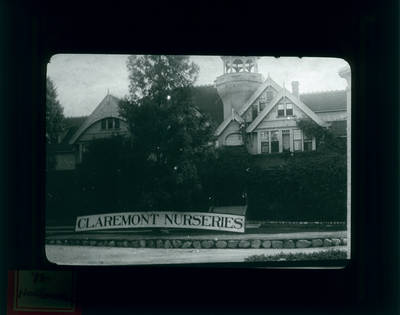
In the spirit of the season, here are some selections from the CCDL which depict Halloween traditions in early twentieth-century Claremont. Enjoy!

The Claremont Colleges Library, Photo Archive, Claremont Colleges Digital Library. 

Leaves

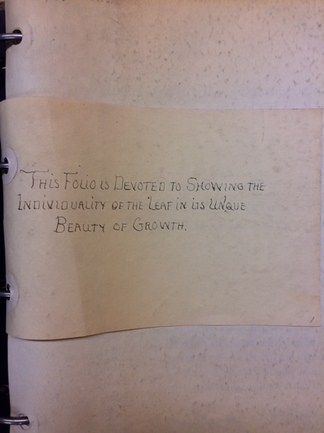
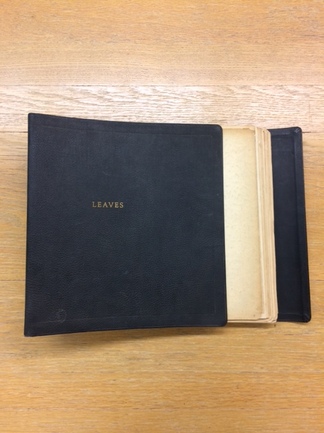
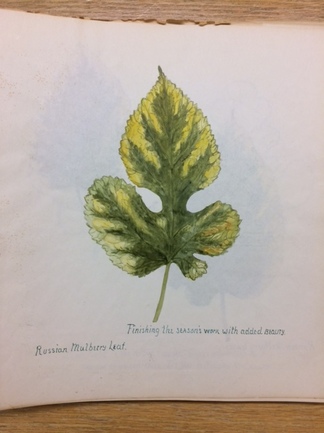
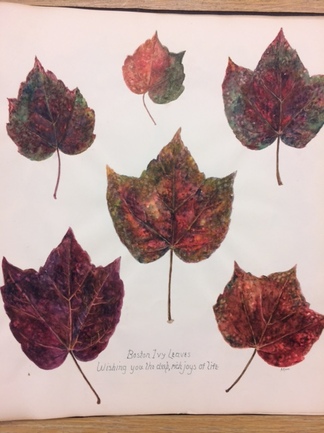
I took a break recently to help with the best kind of archival tedium: numbering the pages of old scrapbooks. The books were created by David French, a Pomona College student in the 1930s. French amassed several folios of his nature drawings and homespun poetry, with each volume dedicated to a different feature of the Claremont landscape (wildflowers and leaves were evidently his particular favorites).

French’s notebooks will soon become part of the Claremont Colleges Autograph and Manuscript Collection here at Special Collections. Lovingly made and steeped in a strong affection for poetry and nature, these folios provide a wonderful glimpse into the mind of a Pomona College student as he documented a much sleepier and more pastoral Claremont

Housekeeping

It’s true! The 13th annual Los Angeles Archives Bazaar is happening this Saturday, October 20, at USC’s Doheny Library. This will be my first time attending, and I can’t wait to explore what’s sure to be a diverse and exciting array of L.A.-centric primary sources. I’m also looking forward to hearing from our colleagues Lisa Crane and Sara Chetney, who will open the day with a presentation entitled “Researching L.A. 101.” You can find out more about the Archives Bazaar here.

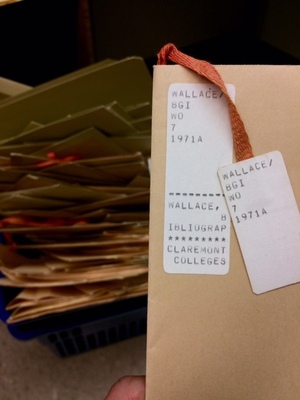
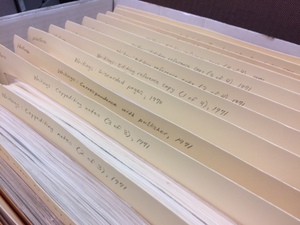
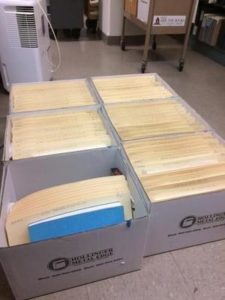
 Back here in CCEPS land, my work with the Wallace collection proceeds apace. The collection’s peculiar, library-style processing scheme–a legacy of Honnold Library’s initial foray into computers in the 1980s–requires wholesale reprocessing according to archival best practices. As you can see from my photographs, reprocessing for The Word series is just about finished, and we’ll soon have the finding aid online and the materials available for research at Special Collections.

 The Wallace collection contains materials from dozens of more books, so our work on The Word represents just one small step toward the eventual goal of complete reprocessing. But it feels good to commence the stepping nonetheless!  

FullSizeRender.jpg
The original processing folders and call numbers. Note the discard basket!
IMG_7437.JPG
Ahh. Much better.
The reprocessed series. Isn’t it pretty?

Designing an Irving Wallace Book

The Irving Wallace collection is a rich resource for the study of American book publishing in the postwar decades. The series dedicated to Wallace’s 1972 novel The Word, for instance, contains five complete drafts at various stages, multiple folders of copy-editing notes, and extensive correspondence between Wallace and his editors at Simon and Schuster. These documents provide a granular picture of the intellectual labor involved in the publishing process.

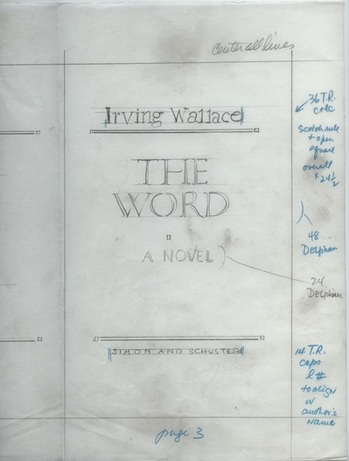
Yet publishing also involves questions of design, as evidenced by this mock-up made by the production department of Simon and Schuster in 1971. While not remarkable in and of itself, this item testifies to the full spectrum of processes–from writing to editing to design to marketing–which shaped an Irving Wallace novel. 

These kinds of materials also offer fertile ground for historians of popular culture, who might question the aesthetic and political values embedded in the mock-up of the title page for The Word. What might the design reveal about the author’s (and publisher’s) intended audience? Do the design elements of Wallace’s books signal challenging polemical art or safe, middle-of-the-road entertainment? And was there a gap between the outward appearance of Wallace’s novels and the content contained within? 

Irving Wallace, On-screen

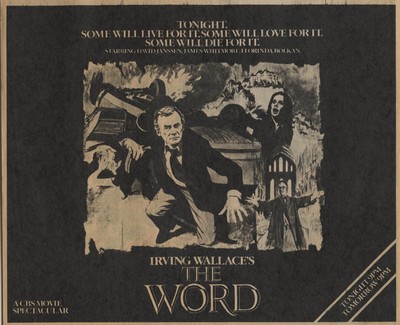
Before he made it big as a novelist, Irving Wallace spent the better part of a decade writing scripts for Hollywood films. His credits were unremarkable, and he found the work intellectually and financially unfulfilling. Nevertheless, Wallace would maintain connections to Hollywood for the duration of his career, and he apparently had few reservations about adapting his books for film and television. Starting with The Chapman Report in 1962 and continuing through CBS’s serialization of The Word in 1978, several of Wallace’s novels went on to enjoy a second life on the big and small screens.

Whatever their merits as art or entertainment, these adaptations highlight the cultural (and commercial) cachet of the Irving Wallace brand in the 1960s and 1970s. Whether in print or on-screen, his work seemed guaranteed to attract a large audience. 

Irving Wallace Meets James Baldwin

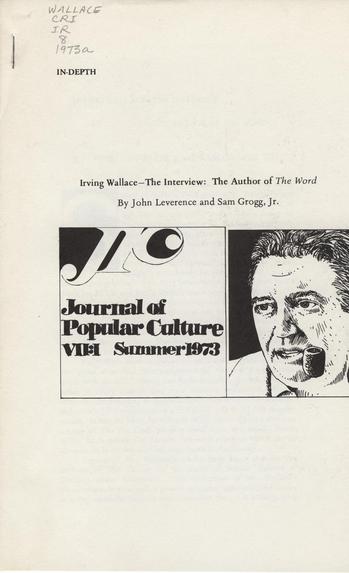
In 1973, fresh off the publication of The Word, Irving Wallace gave a lengthy interview to the Journal of Popular Culture in which he discussed his approach to research and writing, his popular success, and his frustrated relationship with literary critics. The interview offers a clear picture of Wallace’s sharp intellect and wide-ranging curiosity; one minute he’s discussing a recent academic study on the social effects of pornography, and the next he’s meditating on the lingering influence of America’s puritanical culture. The interview confirms my growing sense that Irving Wallace was more thoughtful, funny, humane, and self-aware than the label “popular novelist” would indicate.

By far my favorite part of the interview, however, is Wallace’s recollection of an all-night, cocktail-fueled conversation he once had with the writer James Baldwin, in Cannes. In the interview, Wallace remembers telling Baldwin that he had just finished writing The Man, in which an African American man is elected President of the United States: 

[Baldwin] looked at me with disbelief. “The hell you have. What credentials do you have to do that? How can you write about a black man?” I said, “The same way you were able to write about a white man in your last novel.” He said, “Fair enough.”

According to Wallace, he went on to stress how, as a white writer with a massive audience, he could impact white attitudes about race more readily than Baldwin could hope to — and, moreover, that he had a moral obligation to try.

Baldwin’s reply? “I hope it works.”

For me, this exchange offers a new glimpse into the politics of Wallace’s work, and offers yet another potential avenue which scholars might use to approach him, his work, and his audience.