A Glass Shattering Moment

Now, more than ever, we can ask, “Is it live, or is it Memorex?”

Memorex Ad, 1974

Ella Fitzgerald was the spokesperson for Memorex Recording Tape Company in the 1970s, appearing in print and television advertisements. The Chicago ad agency Leo Burnett developed this campaign in 1970. As a commemoration of the success of this campaign, Memorex held an Awards party for Fitzgerald in Los Angeles on April 6, 1977. The “one of a kind Champagne Goblet” that she received on that day was featured in a Smithsonian Museum artifact highlight video for the “Ella at 100 exhibit in National Museum of American History.”
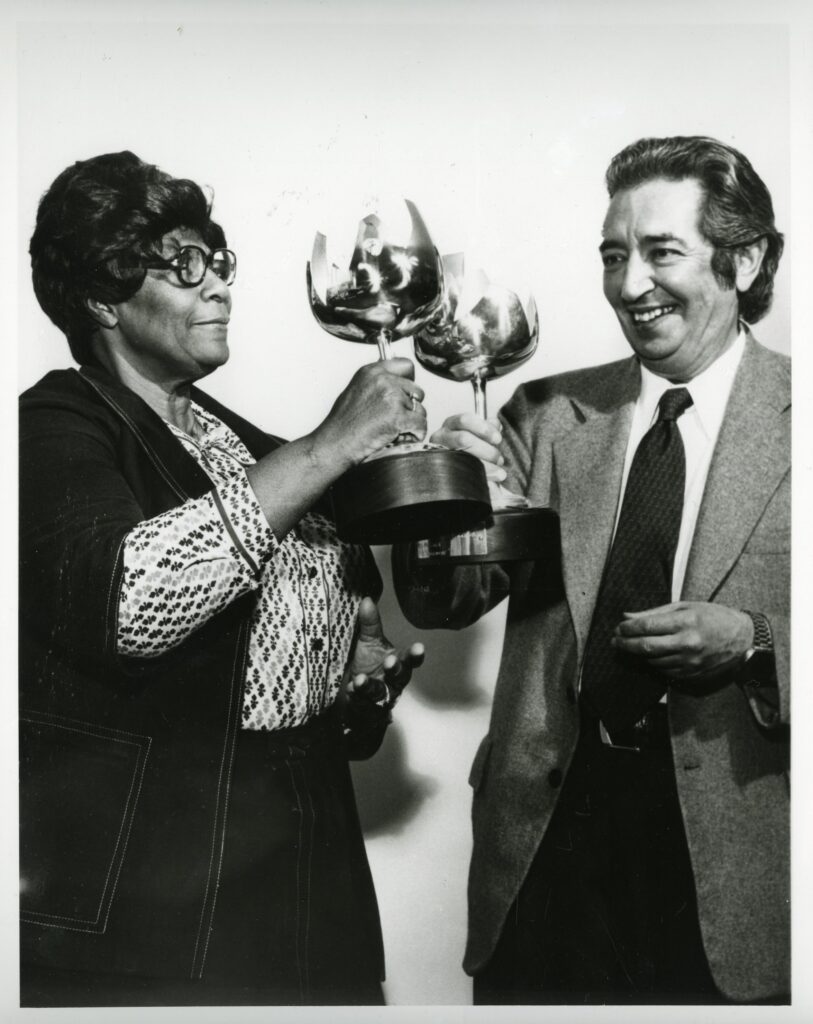
Memorex Awards Party, 1977

In the Irving Wallace papers’ biographical photographs, I came across an image of Wallace and Fitzgerald at that Memorex Awards Party! In another image, Wallace signs a copy of The R Document. And in this image, Fitzgerald and Wallace raise two shattered glass awards in celebration. But I am left wondering why there are two “one of a kind Champagne Goblet” and how Irving Wallace might have been connected to this campaign.

Stay tuned, Chelsea Fox

Work Cited

Hasse, John Edward. “Ella Fitzgerald’s one of a kind Champagne Goblet.” Smithsonian Music: Music Video. Smithsonian, March 2018. https://music.si.edu/video/ella-fitzgeralds-one-kind-champagne-goblet

Mercer, Michelle. “The Voice That Shattered Glass.” All Things Considered. NPR, September 3, 2019. https://www.npr.org/2019/09/03/749019831/the-voice-that-shattered-glass
The Courage of Conviction

“I am a writer, mainly of novels, but also of biography and oddments of history. Most authors believe that a novel should entertain, not instruct. But I am one of those contemporary authors who, more often than not, prefer to make a social statement in their story, to dramatize some belief that they hold dear, even hold passionately.” –Irving Wallace

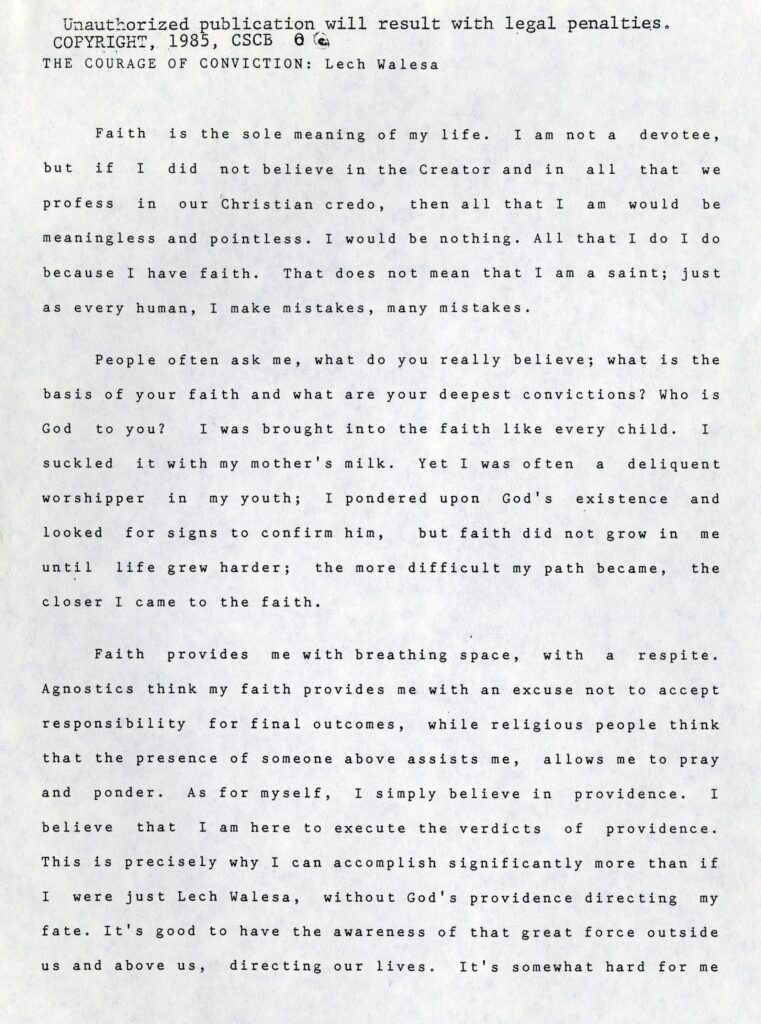
Manuscript, 1985
Ballantine Books, 1986

The Courage of Conviction, published in 1986 and edited by Phillip L. Berman, includes thirty-two essays from a wide range of individuals. From Joan Baez to Joane Goodall to Irving Wallace, this collection of essays offers a portrait into the lives of those who construct their identity around firmly held beliefs or opinions.

The Irving Wallace papers has three items from 1985 for The Courage of Conviction: a galley of the Irving Wallace essay, a list of contributors, and a manuscript of the essay from Lech Walesa. Walesa, the Polish Nobel Peace Prize laureate, wrote, “People often ask me, what do you really believe; what is the basis of your faith and what are your deepest convictions?”

I am reflecting on these themes of the construction of self and the basis of “deepest convictions” as points of historical inquiries. So the question is, how can the archives uncover the beliefs?

Stay tuned, Chelsea Fox

Snapshots of Wallace

A portrait of Irving Wallace through images

Paul Newman, 1963

Photographs and visual materials are in abundance in the Biographical Materials series of the Irving Wallace papers. From illustrated portraits of Wallace to photographs from events Los Angeles, the visual materials range from the early to the late 20th-century—whether family portraits from the 1910s, beach days in Europe in the 1960s, or author pictures for books in the 1980s.

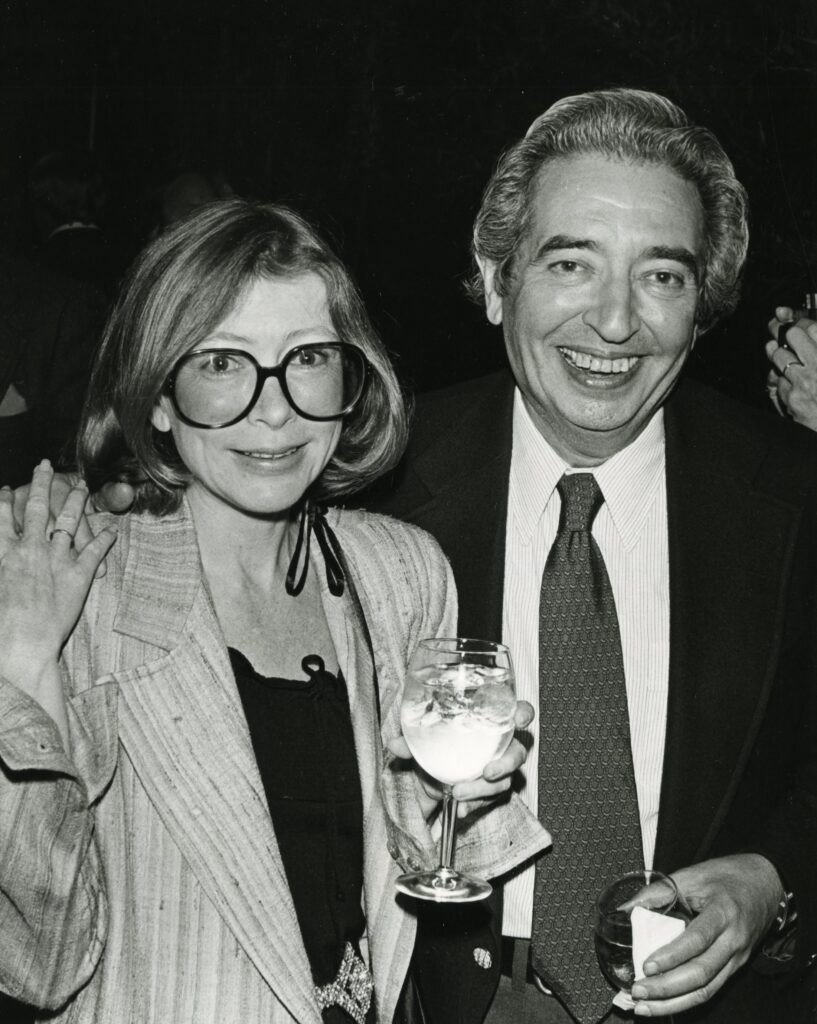
Joan Didion, 1979

What could you find looking through these images? Actors, musicians, politicians, public figures, authors, and more! The photographs feature the actor with Paul Newman on the set of the adaptation of the book The Prize at M.G.M in 1963 and the author Joan Didion at one of Wallace’s parties in 1979. Such interesting stories are waiting in the many photographs of Irving Wallace.

Stay tuned, Chelsea Fox

Reference and Research

What do authors reference and use for research while writing?

Wallace’s copy

Not only do the Irving Wallace papers have the plethora of writings by Wallace. But the collection holds a variety of items that address a simple question: What was Irving Wallace looking at or reading while he was writing?

Photocopies of chapters, newspaper clippings, magazines, screenplays, and manuals offer a glimpse into what Irving Wallace found worthwhile to review during his own work as an author.

“The Razor’s Edge” draft, 1945

To highlight one item in these reference and research materials, there is a rare copy of screenplay by W. Somerset Maugham—an initial draft from1945 of the film “The Razor’s Edge,” which this series also has a final screenplay of from 1946. Developed for 20th Century Fox, Maugham wrote that this draft was “not to be look upon as a script and will be incomprehensible.” As a screenwriter himself, I wonder if Wallace would return to these screenplays for inspiration.

Stay tuned, Chelsea Fox