Processing Parchments

As my fellowship comes to an end, I have completed one last project. This involved processing a collection of archival materials from start to finish, as an individual project. The library had in their possession a document box full of 17th to 19th century parchments that had been folded up and are of unknown provenance. I have a strong interest in British history, so I was excited to find that most of these parchments were from England, with a few American ones mixed in as well.

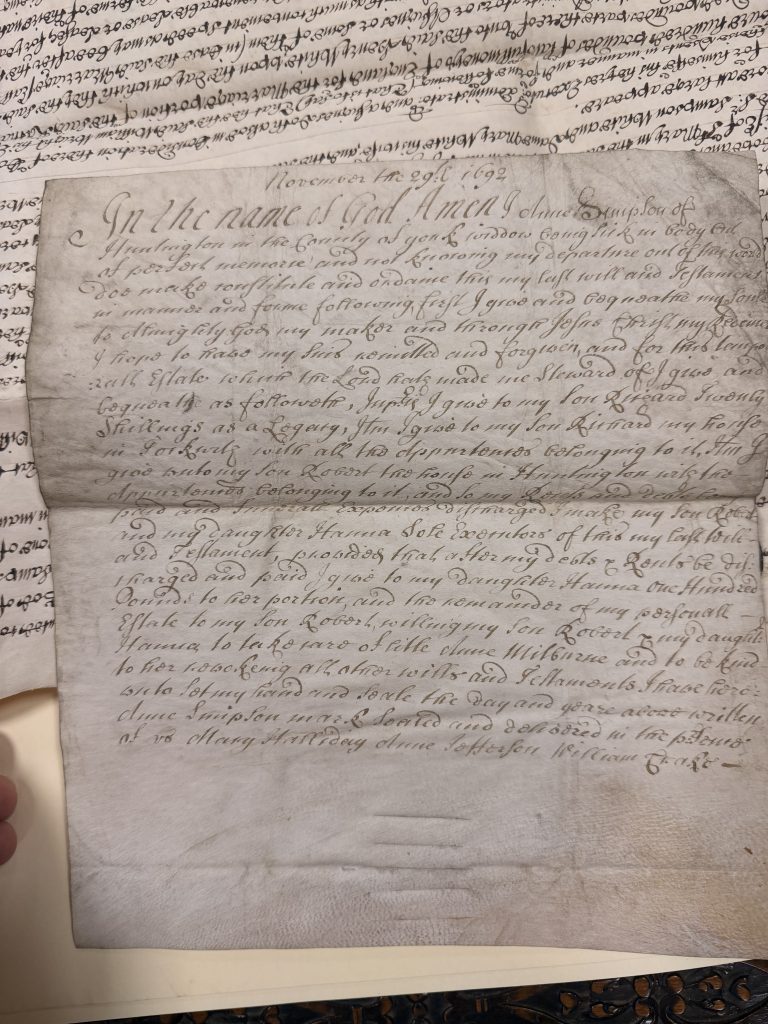
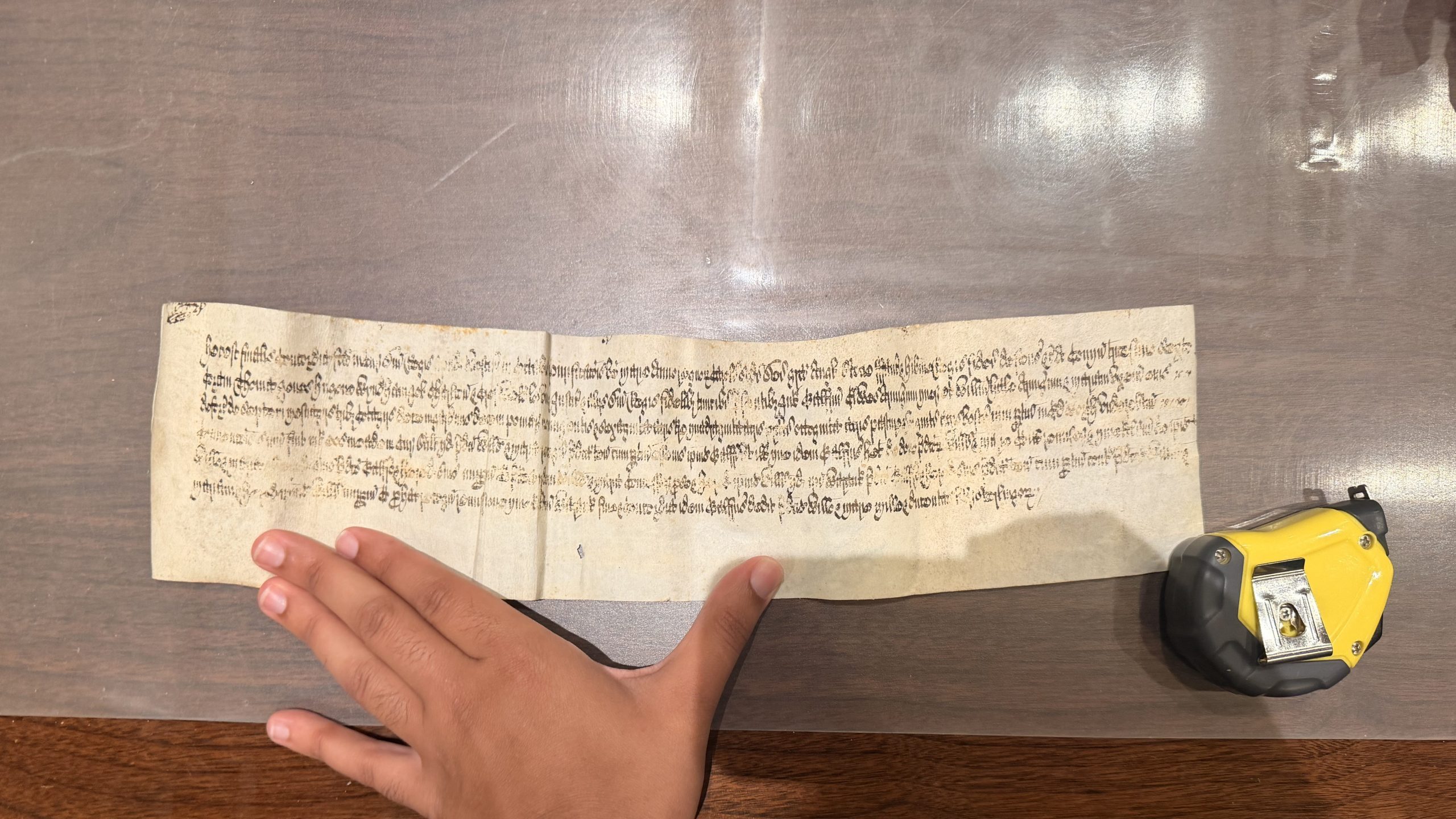
There were two major components of this project: identifying key information about each document and rehabilitating the parchments by relaxing the creases they had acquired from being a box for so many years. The first part involved brushing off my paleography skills to decipher old, cursive handwriting. While many documents were in English, a few were in Latin as well. One parchment strip was written in a language I could not determine, although the script was Latin. I could have spent far longer attempting to read the entirety of each document, but my primary goal was to identify what each document was in order to add them to ArchivesSpace. They all turned out to be legal documents, mostly indentures and deeds concerning land use. One document was a last will and testament from a Virginian widow in 1692, which is a very interesting piece of history. The presence of wax seals, signatures, and Latin all indicated that these were legal documents. I took note of important features and added each document to ArchivesSpace, under the Parchment Documents Collection.
The second part involved moving the parchment documents to a room with a humidifier while they were held down by weights, in order to flatten them as much as possible. The humidity helped speed up the process of relaxing the creases, although there was only so much we could do. After rehabilitating the documents, they were put into an oversized flat box, or map folders, depending on their size. Unfortunately, there was limited space to rehabilitate the documents, so they had to be moved in batches. Currently, the second batch is relaxing in the humidified room, and there is one more batch to go. Therefore, I will not be able to put all of the documents in their correct place before I leave my fellowship, but the process is mostly complete.

Indenture, 1652

This project has strengthened my skills in processing archival documents and inspired me to continue learning. I feel honored to have had the opportunity to work with such interesting rare documents, and I hope to continue my career in special collections and archives. 

Signing Off,

Clara Newkirk

Processing the Trelawny Collection

I have jumped into a new project, which is processing a box from the Trelawny Collection donated by Donald B. Prell. This is an exciting new experience for me as I have processed library books before, but not archival materials. I did not know much about Trelawny beforehand, although I did know more about his contemporaries Percy Bysshe Shelley and Lord Byron. Prell seems to have built an incredible collection dedicated to Trelawny, including many photocopies of his correspondence with other notable figures. I’m already learning so much about him and the interactions he had with his circle of literary friends. The item I found most interesting was his letter to Mary Shelley, as I’m a big fan of Frankenstein. I’m excited to dive in and learn more!

Until next time,

Clara Newkirk

Curating an Exhibit Using Archival Materials – Japanese American Incarceration

Hello! I’m Clara, the inaugural Donald B. Prell visiting fellow in The Claremont Center for Engagement with Primary Sources (CCEPS). I’m a student at the Université Marie & Louis Pasteur, working on my MA in Rare Books and Digital Humanities. This fellowship has given me the opportunity to work in Special Collections, the first major project being curating an exhibit.

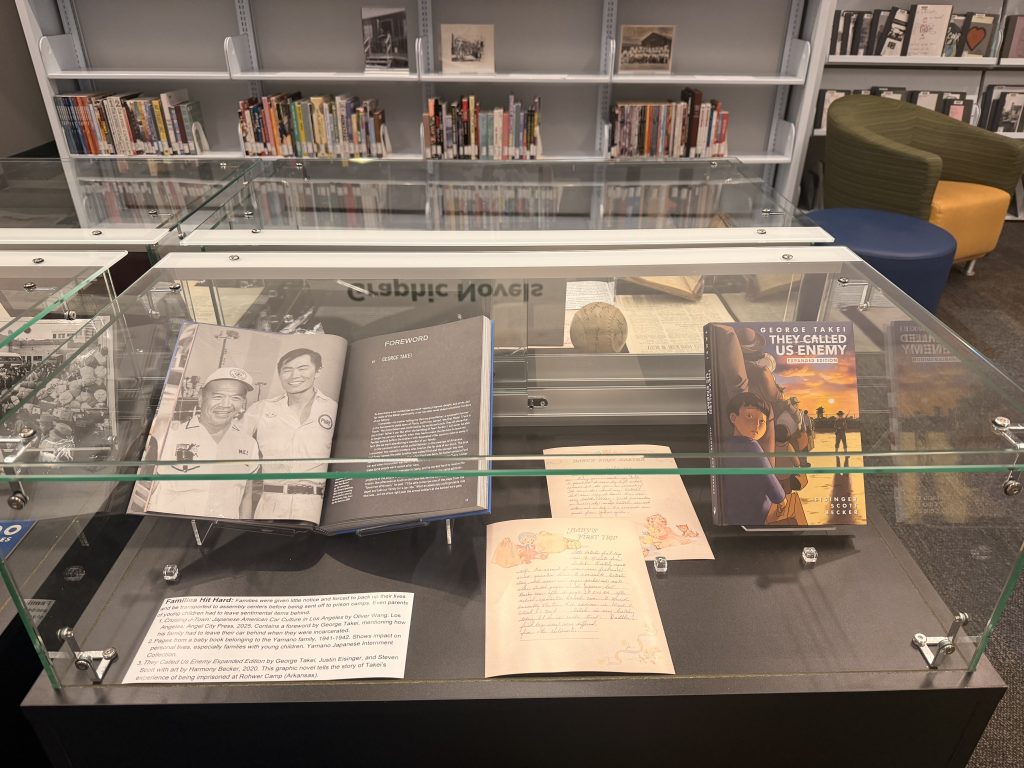
The Claremont Colleges Library has collaborated with the LA County Library for “One Book, One Coast”, a west coast reading initiative that discusses various books, starting with They Called Us Enemy by George Takei. This graphic novel details Takei’s experience at an incarceration camp with his family during World War II, showcasing the heartbreaking reality that many suffered through. For this collaboration, we have curated an exhibit centered on the book.

I have curated a few exhibits before, but I have never had access to such a vast amount of archival materials. The Claremont Colleges Library holds eight collections relating to Japanese American Incarceration during World War II. These collections include photographs, official government documents, and personal items such as a baby book and an autograph book. I spent weeks going through the archives, both digital and physical, in order to find materials that fit the theme of this exhibit.

It is one thing to simply tell the story of what happened during World War II, but the archival materials paint a vivid picture of the past. It was difficult to choose from so many items, as every one tells a part of the story, but I learned to focus on those with the most impact. A baby book with a page to document ‘baby’s first trip’, only for it to be to an incarceration camp; a softball signed by incarcerees that played sports while imprisoned; and a government release order that indicates no remorse on the government’s part for locking up thousands of Americans. These are items that belonged to real people who were forced to abandon their homes and sent to prison camps simply because they are Japanese American.

There are four cases in this exhibit, and each one has a theme. The first case documents the call for a forced removal of Japanese Americans, with the U.S. government branding everyone of Japanese heritage an enemy, even if they were American citizens. The second case includes the graphic novel by George Takei, and pages from a baby book to highlight the impact of the forced removal on families. The third case focuses on life in the incarceration camps, where Japanese Americans played sports and published newspapers, attempting to carry on with their lives despite the circumstances. The fourth case is about the difficulty of resettlement after incarcerees were unceremoniously released with very little support. People such as George Takei still carry these experiences with them in the present day, and this exhibit is a reminder of that fact.

There were several photographs and documents attesting to the participation of Japanese Americans in the U.S. military during this time, despite not being treated like citizens by the very government they were fighting for. However, as this exhibit centers around George Takei’s graphic novel and he was not a soldier, I had to exclude archives which told that story. Perhaps a future exhibit focusing on the military could include those materials. Special Collections has such a large amount of materials that an almost infinite number of exhibits could be created on a multitude of topics. There will always be more to learn and then showcase to the community.

Curating this exhibit has taught me more about the history of this country—especially what it has done to its own citizens—and I hope it teaches others as well. The “They Called Us Enemy: Japanese American Incarceration during WWII” exhibit will be on display until July 1 on Mudd 2.

Until next time,

Clara Newkirk