Chaffey Letters Book 2

Hi everyone,

This week I worked on naming files from the second book of Chaffey letters.

In a few of the letters from Book 2 that
I got to skim, I came across some business issues the Chaffey
brothers had to deal with. A common theme was that
the person they were writing to wasn’t writing back to them in time. The
brothers were dealing with pressing issues at times, but the speed of the postal service (and potentially the reluctance of their business partners to
answer) meant they didn’t always get a response when they needed one. For
example, in the file ont00017_0103_0002, George Chaffey wrote about rabbits
doing damage to trees on their land, and how the person he was addressing had
left his letter unanswered. This made me think of how nowadays we are
accustomed to instant responses, and if we don’t get them, we can often check
whether or not our messages have been received or even opened. People are also
expected to be accessible at any time because our cell phones are never too far
from us. This has changed business practices and customs so much. It was
interesting to read how it used to be in the 1800s, and how all the Chaffey
brothers could do to ensure a faster response was to perhaps insert some stern
words into their requests.

Speaking of the digital age, I also worked on posting to CLIR and Honnold’s social media pages today!

Best,
Aalia

Normal
0

false
false
false

EN-US
X-NONE
X-NONE

/* Style Definitions */
table.MsoNormalTable
{mso-style-name:”Table Normal”;
mso-tstyle-rowband-size:0;
mso-tstyle-colband-size:0;
mso-style-noshow:yes;
mso-style-priority:99;
mso-style-parent:””;
mso-padding-alt:0in 5.4pt 0in 5.4pt;
mso-para-margin-top:6.0pt;
mso-para-margin-right:0in;
mso-para-margin-bottom:6.0pt;
mso-para-margin-left:41.75pt;
line-height:22.0pt;
mso-pagination:widow-orphan;
font-size:11.0pt;
font-family:”Times New Roman”,”serif”;
mso-ascii-font-family:”Times New Roman”;
mso-ascii-theme-font:minor-latin;
mso-hansi-font-family:”Times New Roman”;
mso-hansi-theme-font:minor-latin;
mso-bidi-font-family:”Times New Roman”;
mso-bidi-theme-font:minor-bidi;}
Full Circle

Hello! I have some pretty amazing news! At this point in the
semester I have now created metadata for all of the items I scanned this
semester. After hours and hours of work I’m done with my first batch of
objects! Once they have all been uploaded onto the digital library I will start
scanning again.

Things have come full circle, officially, which is such an
incredible realization. I actually had trouble thinking of a blog post topic
for this week until I realized I’ve finally seen the process from start to
finish. I guess I have to stop feeling like a newbie now.

I’m excited to start scanning again, something you probably
didn’t expect to read. However, new documents to scan equals new stories to
uncover and I can’t wait to share what new treasures I discover.

Normal
0

false
false
false

EN-US
X-NONE
X-NONE

/* Style Definitions */
table.MsoNormalTable
{mso-style-name:”Table Normal”;
mso-tstyle-rowband-size:0;
mso-tstyle-colband-size:0;
mso-style-noshow:yes;
mso-style-priority:99;
mso-style-parent:””;
mso-padding-alt:0in 5.4pt 0in 5.4pt;
mso-para-margin-top:0in;
mso-para-margin-right:0in;
mso-para-margin-bottom:10.0pt;
mso-para-margin-left:0in;
line-height:115%;
mso-pagination:widow-orphan;
font-size:11.0pt;
font-family:”Calibri”,”sans-serif”;
mso-ascii-font-family:Calibri;
mso-ascii-theme-font:minor-latin;
mso-hansi-font-family:Calibri;
mso-hansi-theme-font:minor-latin;}

Archiving PDFs

Hi all,

This week I worked on converting PDF scans of the Chaffey Letters Book 1 into archivable PDFs, or PDF/As. I did a little research into why it’s necessary for these files to be in the PDF/A format and found that this allows them to be preserved more carefully so that they remain accessible. It’s used by governments, newspapers, libraries, and many more institutions as the world’s information becomes more and more digitized. So, although the work was tedious, it ensured that the Chaffey letters meet the standards for digital archiving.

Happy December,
Aalia

Last Day at the Office

Hello everyone,

So today is my last day working as a CLIRWater CCEPS Fellow. For the past two days I have been working on my presentation displaying the work I’ve done this semester as well as continuing metadata for those Chaffey Letters. It might be a surprise, but my end of the semester presentation is going to be on… drum rolls please..

The Chaffey Letters!!

I’ve spent so much time with these letters and learning about the Chaffey Brothers, the Inland Empire and Ontario that I’m just waiting to burst with all that information.

Overall, I am thankful for the experience I have had at the library. I have always considered myself a history buff and while working with these documents I have enjoyed learning about the history of Southern California as well as the ability to work with archives. I’ve learned new skills, technical and job skills.

thanks for reading,

Alfonso

Presentations

The semester is almost over and there’s a lot to do before it ends. As a student I have been busy working on wrapping up coursework and writing final papers. But as a CLIR CCEPS Fellow I have also been working on a culminating project for the semester. 

Next Wednesday, December 6, I will be doing a presentation about my experiences along with the rest of the CLIR CCEPS Fellows. Each person will speak on a different topic that interests them and directly relates to their time here at special collections working on the CLIR Water documents. The event will be held at 2pm in the library’s Founders Room.

At first I was overwhelmed with the idea of presenting my thoughts on the project to digitize this huge collection of documents relating to water resources in Southern California. Even though I have been here almost an entire semester, at times I feel like I have barely scratched the surface of the collection. However, in thinking more about the upcoming presentations I have realized I have a wealth of thoughts and ideas about the project.

I won’t tell you what my topic is yet though! No spoilers! But if you want to come you can always check out the Facebook event here: https://www.facebook.com/events/363071144142301/

Thankful

Since it is Thanksgiving week I thought I would talk about the things I am thankful for as a CLIR CCEPS Fellow.

1. Tanya, the Special Collections CLIR Digital Project Manager: Tanya is the driving force of the CLIR Water Project. She uses her knowledge and expertise to guide the CLIR CCEPS fellows. Without her, the project would not be possible. I am thankful for her because she has taught me an immense amount about archives, libraries, and special collections.

2. The Other CLIR CCEPS Fellows: I could not tackle the task of digitizing and uploading this collection by myself. The other CLIR CCEPS Fellows are similarly dedicated to making this collection of water documents accessible on the Claremont Colleges Digital Library. I am thankful for them because of their hard work as we work together to complete this project.

3. The Special Collections and Claremont Colleges Library Staff: The staff here is always friendly and ready to help me with any issue I may have. I am thankful for them because as a student and as a worker they are always able to share knowledge and insight.

4. Podcasts: Whenever I am working on the more monotonous tasks, like scanning a large document, I like to listen to podcasts. They keep my brain busy while I do less exciting tasks so I never get bored at work. I am thankful for podcasts because they keep me entertained.

5. Technology: I’ve already talked about technology in a previous blog post, but it is so vital to what we do here. I am thankful for technology because it makes my life easier.

6. The People of the Past: Where would we be without the people of the past? We could not do research about water resources in Southern California if the people in this area had not written letters, drawn maps, created documents, completed reports, or recorded any of the material that we now possess. I am thankful for the people of the past for documenting their lives and activities so that we could learn about them today.

Happy Thanksgiving!

Getting started with the CLIR Water Project

Hello, fellow followers of the water history of Southern California!

I’m Aalia, a freshman at Pomona College, and I recently joined the CLIR Water team here at good old Honnold-Mudd library. During my first two weeks, I have been working with Book 1 of the Chaffey letters. I checked the scans of the original letters against their transcripts to make sure the files were paired together correctly, then filled in some of their metadata in the Excel spreadsheet tracker.

As we know, there are hundreds of these letters, so I didn’t really get to read each one- if I had, I’d be working on that same task right now, and for the next several days! But I did get to skim a lot of the documents, and it was fascinating to get a glimpse into a different era and its form of communication. My freshman critical inquiry course this semester revolves around letters and the role they play in our lives and societies, so I’ve been thinking about the purpose, context, and form of various letters for the past couple months. Applying this thought process to the Chaffey brothers’ correspondences has made me observant of the particular language they use and how it conveys their meaning, the openings and closings of each letter, and the tone the writers use when dealing with different issues. The opportunity to explore these themes as I compiled rows and rows of metadata definitely spiced up the job.

So far, I’ve learned how to work on metadata and how to convert PDFs to PDF/As. I’ve also realized that Excel can be tricky- I accidentally messed up the configuration of a spreadsheet when I was trying to add rows- so I am trying to be even more careful with these little details!

See you after Thanksgiving,
Aalia

Level three!

I’ve begun metadata on the Chaffey Letters, Book I! I’ve never been into video games much but I assume that the feeling of passing a level you tried over and over to pass is the same feeling I’ve felt these past two days. I suppose I should clarify what level one and two were, as well. 

Level One: Scanning. The Chaffey Letters (Book I and II) took an extremely long time to scan. Each book had such a large number of extremely thin and fragile paper.

chaffey bhs.jpg

Level Two: Breaking up the letters. Along with the Chaffey Letters, Ontario City Library provided us with transcripts for each letter. The past few weeks I have been breaking apart the letters, from one large pdf with all the letters into individual pdfs for each letter (as well as individual pdfs for each transcript).

Level Three: METADATA! Now that the sources are scanned and separated I have begun metadata so the hundreds of Chaffey Letters we have can go live (that’s how you win this video game, in case you were wondering). With the letters we have to attach their transcripts and process them as ‘compound objects,’ so the letters will be able to be viewed on the Claremont Colleges Digital Library with the transcripts.

Here’s to many more hours on metadata!

Till next time, Alfonso

Learning Through Osmosis

I’m becoming a historian through osmosis. After a couple of weeks of creating metadata, I have an increasing understanding of the documents and the context in which they exist. I already knew some things from scanning documents and looking for interesting tidbits for social media and blog posts.

Now that I’m creating metadata, my understanding of the topics in our collection has increased tenfold. This is the nature of creating metadata, I am trying to synthesize information contained in the document so that when it is uploaded researchers browsing our collection will be able to filter through the material.

It is obviously interesting to learn about major historical events like the construction of the Hoover Dam, but it may be more surprising to hear that my favorite things to learn about are the less significant narratives. This week, for example, I created metadata for a series of letters written between 1935 and 1938 between the City of Ontario and the Metropolitan Water District of Southern California.

During this time the Colorado River was seen as the solution to the water scarcity problem in Southern California. Increasing numbers of people settling in the area meant increasing amounts of water was required for both agricultural and domestic use. Southern Californians looked east to the Colorado River, one of the largest rivers in the United States for assistance.

A dam in the Boulder Canyon was proposed and subsequently an aqueduct leading to Southern California. The Metropolitan Water District of Southern California was responsible for the building of the Colorado River Aqueduct. The Metropolitan Water District of Southern California originally encompassed Anaheim, Beverly Hills, Burbank, Compton, Fullerton, Glendale, Long Beach, Los Angeles, Pasadena, San Marino, Santa Ana Santa Monica, and Torrance. Later on it would include dozens of Southern Californian cities including Ontario.

This series of letters, however, gives a smaller, more intimate, and incredibly interesting history of this time. According to letters from the City of Ontario, several city streets had been damaged by the construction of the Colorado River Aqueduct. The letters addressed to the Metropolitan Water District of Southern California requested that they cover the cost required to repair the city streets. This correspondence continues with the Metropolitan Water District of Southern California’s denial of responsibility of the damage.

Between 1935 and 1938, the City of Ontario and the Metropolitan Water District of Southern California send letter after letter until a conclusion is made. According to one of the final letters, an Ontario City Council meeting passed a resolution that freed the Metropolitan Water District of Southern California from liability for the damage done during the construction of the Colorado River Aqueduct.

As I created metadata for these items, I was intrigued by this story. Although it is not a major event in the history of Southern California, it is an interesting narrative that could very easily have been lost to time. Instead I am able to make these letters available to researchers through the Claremont Colleges Digital Library.

Social Media, but like from the past?

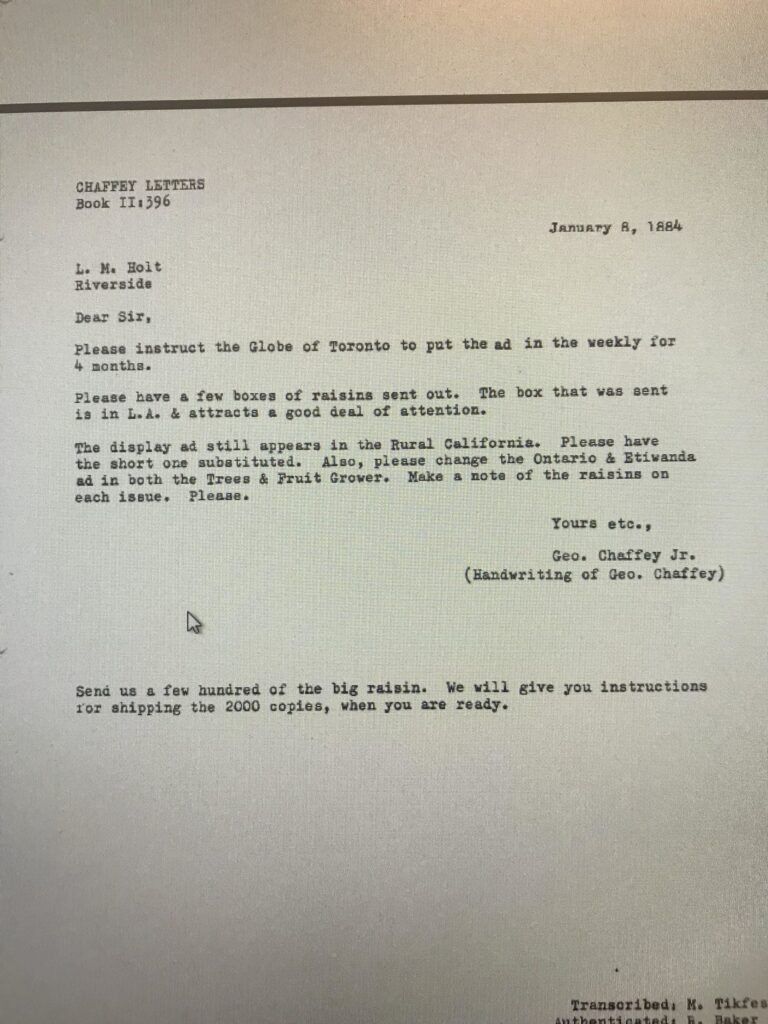
Inspired by Kiera’s blog about social media, I began to think of the Chaffey brothers and their use of advertisement and marketing in order to attract attention to their “Colony.” As we saw in a past blog of mine, the Chaffey brothers had produced pamphlets about their “City that Charms.”

They truly created a sort of paradise area for people to come, to live and to prosper. “It’s like Social Media, but old.” *said in a high pitched voice* They really did have their own forms of social media, their own forms of putting information out there. Nowadays if we have an idea we have an immediate outlet, but it wasn’t always that easy. In the letter below one can see how advertising was very important to the Chaffey brothers.

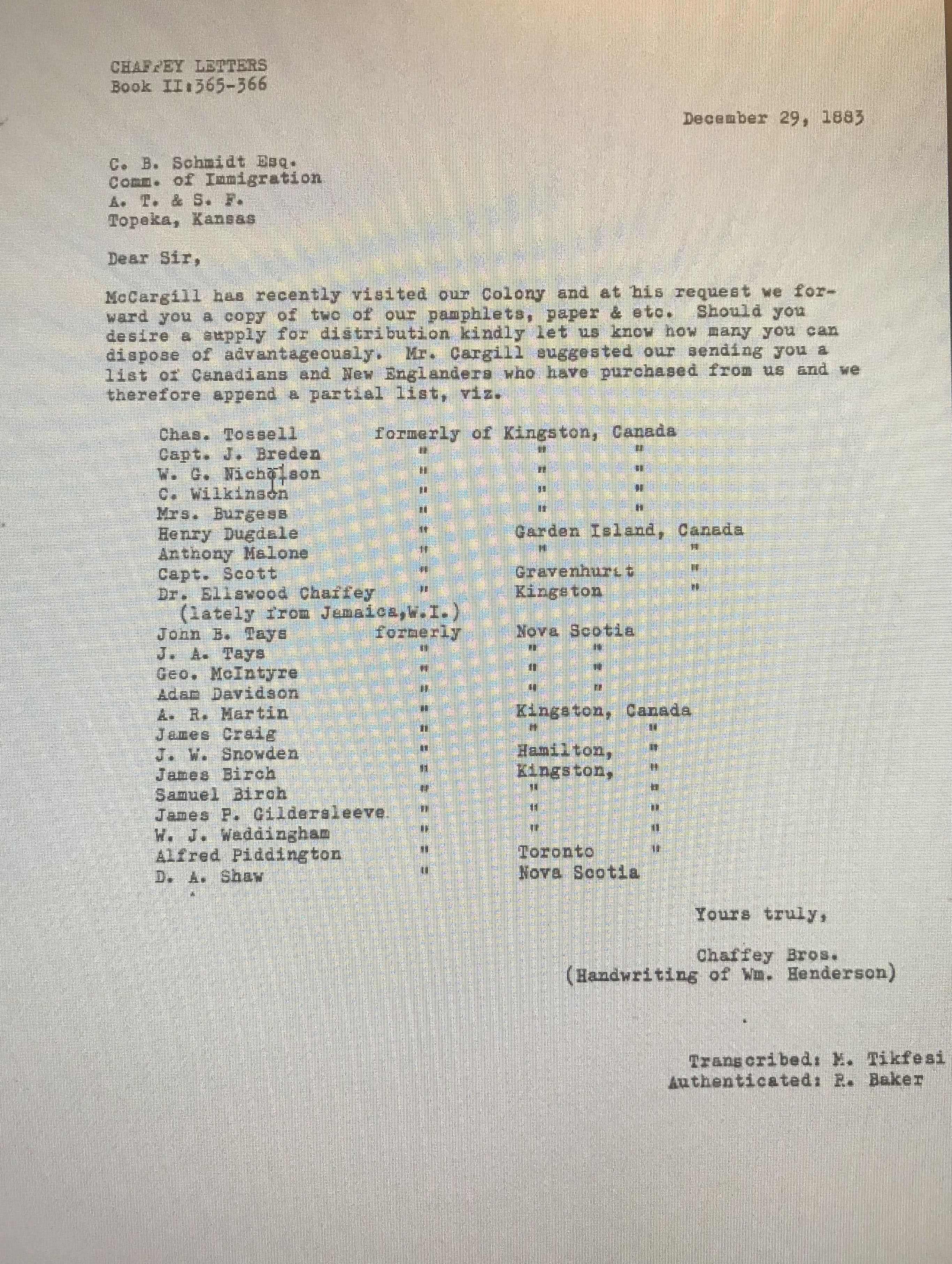
They had advertisements all around the area, and even in Canada. In another letter you can see the amount of people from Canada interested in the Colony the Chaffey Brothers created.

chaffeyletterscanadians.jpg

They really had a vision!

Until next time,
Alfonso